The slot machine in your pocket.
The gestures were accidents. The reward schedule wasn’t.
The thumb: a machine that never says you are finished
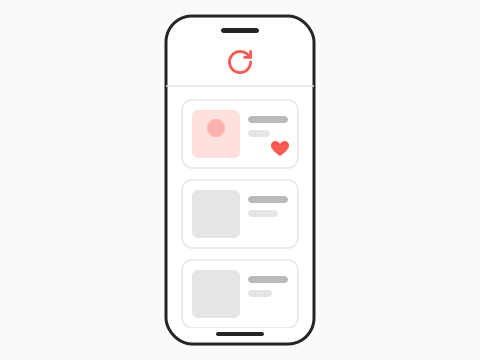
You open Instagram and pull down.
A small animation appears. For a moment, nothing happens. Then the screen changes. A friend has posted a photograph. Someone has commented on your work. A stranger has shared something you have never seen before. Perhaps there is nothing particularly interesting at all. You scroll, pull again, and wait.
The next refresh might be worth your attention. It might not be.
That uncertainty is the point.
A slot machine offers a familiar ritual: pull a lever, watch the reels turn, and wait to discover whether the machine will reward you. Instagram offers a digital equivalent. Pull to refresh. Watch the interface move. Wait for new content. Inspect the results. Repeat.
The rewards are different, but the underlying structure is remarkably similar. One machine offers the possibility of money; the other offers the possibility of social recognition, entertainment, novelty, or information. Neither promises that the next action will produce something worthwhile.
This is not an argument that Instagram and a casino are identical. They are not. People use social networks to maintain friendships, build businesses, learn new skills, and participate in communities. Their value is real. Nor does every person who checks Instagram experience compulsive use.
The more important question concerns the mechanism through which a useful product can become difficult to put down.
In 2016, former Google design ethicist Tristan Harris published How Technology Hijacks People's Minds, describing how digital interfaces exploit predictable features of human psychology.9 In 2019, Harris took that argument to the United States Senate, explaining how the combination of unpredictable rewards and missing stopping cues could make a social-media feed operate like a slot machine.10
His argument identified a tension at the center of modern product design: the same interface that makes a service convenient can also make it unusually effective at capturing attention.
The distinction matters because the history of these interfaces is not a simple story of malicious inventors. Loren Brichter, who created pull-to-refresh, and Aza Raskin, who developed infinite scroll, have both been associated with subsequent criticism of the ways their inventions were used.1112 Their stories illustrate how an interaction designed for convenience can acquire a different purpose when incorporated into a business optimized for engagement.
The gestures may have begun as solutions to usability problems. Their commercial significance emerged from what companies did with them afterward.
The central argument is straightforward: the gestures were not necessarily invented to create compulsive behavior, but the systematic optimization of unpredictable rewards and uninterrupted engagement turned them into instruments of attention capture.
Understanding that distinction requires going back to a laboratory, where researchers discovered that the timing and predictability of rewards could profoundly change behavior.
The pigeon: why unpredictable rewards win
In the 1950s, psychologists B. F. Skinner and Charles B. Ferster investigated how different reinforcement schedules influenced behavior. Their work, collected in Schedules of Reinforcement (1957), helped establish an important principle: behavior depends not only on whether a reward is available, but also on the conditions under which it arrives.1
Imagine a pigeon in a laboratory pressing a small lever to receive food.
In the first arrangement, every press produces food. The relationship between action and reward is clear. The pigeon learns quickly that pressing the lever is worthwhile.
In another arrangement, food arrives after a fixed number of presses. For example, every fifth press produces a reward. This is a fixed-ratio schedule. Once the animal learns the pattern, it can anticipate when the next reward will arrive.
Now consider a third arrangement. The pigeon receives food after an unpredictable number of presses. Sometimes the reward comes quickly; sometimes several presses produce nothing. The animal cannot identify a reliable sequence that tells it when the next reward will appear.
Definition
A variable-ratio schedule rewards an action after an unpredictable number of attempts, so no run of failures reliably signals that the opportunity has ended.
The distinction is important because the animal cannot confidently conclude that the next action will be unrewarded. A series of unsuccessful attempts does not necessarily mean that the next attempt will fail. Nor does an earlier reward mean that another one is imminent. Each new action preserves the possibility of success.
Variable-ratio schedules can generate high, persistent response rates. Behavior reinforced under these conditions can also be relatively resistant to extinction: when the reward disappears, the subject may continue responding because the absence of a reward has never been a reliable signal that the opportunity is over.
The logic is intuitive. If a machine rewards every fifth action, a person can learn the pattern and anticipate the next payout. If a machine rewards an unpredictable number of actions, every unsuccessful attempt leaves open the possibility that the next one will succeed.
This is why slot machines are a useful comparison.
The player does not know which pull will produce a favorable result. The uncertainty sustains the possibility of a reward even during periods when no reward arrives.
However, unpredictability alone does not explain the entire experience. A second question remains: why does uncertainty sometimes feel compelling before the reward is even delivered?
The answer involves the brain's system for learning from reward.
In their 1997 paper, A Neural Substrate of Prediction and Reward, Wolfram Schultz, Peter Dayan, and Read Montague described how dopamine-related neural activity reflects differences between expected and received rewards.2 This difference is known as a reward prediction error.
When an outcome is better than expected, the prediction error is positive. When an expected reward fails to arrive, the prediction error can be negative. As an organism learns to predict a reward, the neural response can shift from the reward itself toward the cue that reliably predicts it.
This is not the same as saying that dopamine is simply a chemical of pleasure. Dopamine participates in several processes, including learning, motivation, and the regulation of action. Its role cannot be reduced to a single slogan about happiness.
The implication for product design is nevertheless significant: unexpected outcomes can teach a person to repeat the actions that preceded them.
A refresh that produces an interesting message can reinforce the habit of refreshing. A notification that leads to meaningful social interaction can make future notifications more salient. A post that receives an unexpectedly large number of likes can influence the person's expectations about posting again.
In 2003, Christopher Fiorillo, Philippe Tobler, and Wolfram Schultz examined how dopamine neurons represented reward probability and uncertainty.3 Their findings included sustained activity under conditions of reward uncertainty, with particularly strong responses in certain experimental conditions around intermediate reward probabilities.
The study helps explain why uncertainty can influence motivation. It does not establish that a social-media feed produces an identical neural response in every user, nor does it prove that a particular interface causes addiction. Laboratory findings about reward processing must be distinguished from conclusions about complex human behavior.
The useful lesson is narrower and stronger: unpredictable outcomes can reinforce repeated actions, and designers who control the timing and presentation of rewards can influence the conditions under which those actions occur.
The pigeon does not need to understand the schedule. It only needs to learn that pressing the lever sometimes works.
The user does not need to understand an engagement algorithm, either. They only need to learn that refreshing, scrolling, or checking a notification sometimes produces something worth finding.
The casino: selling continuity instead of wins
In Addiction by Design: Machine Gambling in Las Vegas (2012), anthropologist Natasha Dow Schüll examined the relationship between gambling-machine design, the gambling industry, and the experiences of people who play electronic machines for extended periods.4
Her research shifts the focus from the individual reward to the experience surrounding it.
A conventional understanding of gambling assumes that the player is trying to win money. That is certainly part of the attraction. Schüll's ethnographic research, however, describes players whose relationship with machines cannot be explained by financial outcomes alone.
Some describe entering a state in which the outside world recedes. Schüll calls this experience the machine zone. The player's attention narrows toward the machine, and the continuity of play can become more important than the result of any particular round.
The machine zone is not simply a euphoric reaction to winning. It can involve repetition, concentration, and a temporary withdrawal from ordinary concerns. Players may continue even when the financial consequences are negative.
This creates a distinction between two possible objectives.
The first is to maximize the player's chance of winning. The second is to maximize the amount of time the player spends interacting with the machine.
These objectives are not equivalent.
A machine that reliably produces a satisfying outcome and then encourages the player to leave might serve the first objective. A machine designed to maintain engagement through repeated cycles of anticipation and action serves the second.
Schüll's analysis describes an industry in which the design of gambling environments and machines is closely connected to keeping players engaged. Interface details, feedback, speed, and the continuity of play can all affect the experience.
The underlying commercial question is therefore not merely whether a player wins. It is whether the system encourages another round.
Digital products operate under different economic and regulatory conditions, but a similar distinction appears in their metrics.
A product team might measure whether users accomplish a task, learn something, establish a connection, or solve a problem. Alternatively, it might focus on daily active users, session length, return frequency, and the number of interactions generated per session.
Engagement metrics can be useful. If people abandon a service immediately, that may indicate that it is confusing, unreliable, or irrelevant. If customers return to a language-learning application every day, that may reflect genuine progress.
The danger arises when the metric becomes the objective regardless of the value being delivered.
If a team is rewarded for increasing time spent in an application, it may discover that removing interruptions produces better numbers. If users tend to leave after completing their original task, recommendations can keep them browsing. If a natural stopping point reduces session duration, the product can be redesigned so that the stopping point is less visible.
No single decision necessarily demonstrates malicious intent. The cumulative result, however, can be a system in which the user's attention is continuously solicited even after the original purpose of the visit has been fulfilled.
This is where Schüll's work becomes relevant to social media. The analogy is not that Instagram is literally a gambling machine. It is that both environments can be designed around continuity of interaction, with rewards and interruptions arranged to influence whether the person continues.
A casino machine does not need to deliver a profitable outcome every time. A feed does not need to deliver a meaningful post every time. Both can remain attractive if the possibility of the next reward is sufficient to motivate another action.
The most important question for a product team is therefore not simply, How do we make the next interaction satisfying?
It is also, Why should the user need another interaction after this one?
The machine in your pocket: Instagram's reward architecture
Instagram's interface does not reproduce a casino's machinery literally. It reproduces aspects of the reward structure.
The comparison becomes clearest when each element is examined separately.
Pull-to-refresh is the lever. Pull-to-refresh gives the user a simple, physical gesture for requesting new information. The gesture is intuitive. It gives the user a sense of control and makes updating a feed feel immediate. Before the interaction became common, refreshing information often required a more explicit command or navigation action.
Loren Brichter developed pull-to-refresh while working on the Twitter application Tweetie. In subsequent interviews, he has reflected on the unintended consequences of the interaction and the way it became embedded in applications far beyond its original context.11
The ethical lesson is not that the gesture should never have been invented. A refresh gesture can be a sensible usability improvement. The concern is what happens when the gesture becomes the repeated action through which a person searches for unpredictable rewards.
Each pull asks the same question: Is there anything new? The action is inexpensive, easy to repeat, and sometimes rewarding. When it produces a meaningful result, the user has a reason to try it again.
The algorithmic feed is the reel. A slot machine displays a sequence of symbols. A social-media feed displays photographs, videos, comments, recommendations, and advertisements. The important difference is that the contents of a personalized feed are selected and ordered algorithmically. The user does not necessarily know what will appear next, and the next item may be substantially more interesting than the previous one.
In March 2016, Instagram replaced its chronological feed with an algorithmically ordered feed.14 The company presented the change as a way to show people the moments they cared about rather than allowing important posts to disappear beneath a flood of newer material.
That objective has a legitimate product rationale. Ranking can help users discover relevant information and manage large volumes of content.
But algorithmic ranking also changes the reward environment.
A chronological feed provides a relatively understandable ordering principle: newer posts generally appear before older ones. An algorithmically ranked feed introduces a more complicated selection process. The next item may be a close friend's photograph, a viral video, an advertisement, or a recommendation from an account the user does not follow.
That variability can increase the incentive to keep browsing because the user cannot reliably predict when the next compelling item will appear. The feed becomes less like a list that can be completed and more like a stream that must be explored.
Likes and badges are the payout lights. Social-media rewards are not limited to content consumption. Users also receive feedback about how other people respond to their own contributions. Likes, comments, follows, mentions, and badges can signal approval, attention, belonging, or achievement.
Nir Eyal's Hooked: How to Build Habit-Forming Products (2014) identifies three broad categories of variable rewards: rewards of the tribe, rewards of the hunt, and rewards of the self.5
- Rewards of the tribe arise from social relationships. A comment from a friend or a response from a professional community can make a person feel recognized.
- Rewards of the hunt arise from the search for resources or information. A user may find an entertaining video, a useful tutorial, or a valuable business contact.
- Rewards of the self arise from personal progress, mastery, and completion. A person may enjoy finishing a creative project, organizing a collection, or improving a skill.
These categories help explain why social-media platforms can deliver value beyond entertainment. The same service can connect a person to friends, provide new information, and support a sense of achievement.
They also help explain why rewards can be difficult to predict. A post might receive little attention one day and considerable attention the next. A notification might lead to an important conversation or an inconsequential reaction. A search might produce nothing useful until an unexpectedly valuable result appears.
Research by Lauren Sherman and colleagues, published in Psychological Science in 2016 as The Power of the Like in Adolescence, examined how adolescents responded to photographs displaying different numbers of likes.7 Their neuroimaging results indicated that seeing highly liked photographs was associated with greater activity in reward-related brain regions, including the nucleus accumbens.
This is evidence that social endorsement can influence neural responses in adolescents. It is not proof that every like is addictive, that the response is unique to social media, or that the platform inevitably causes psychological harm.
Nevertheless, it supports a central point: social feedback can function as a meaningful reward, especially when the user's social relationships and self-presentation are involved. Unlike a cash payout, the value of a like is partly determined by who gave it, what the person posted, and what the response means in a particular social context.
Infinite scroll is the missing cash-out moment. Traditional activities often provide natural endpoints. A newspaper ends. A book has chapters and a final page. A meeting finishes. A task is completed. Even a video usually has an ending, unless it automatically leads into another.
Infinite scroll removes one of the simplest stopping cues: the bottom of the page.
Aza Raskin, who developed infinite scroll in 2006, has subsequently criticized how such interfaces can encourage continued use.12 His reflections illustrate the gap between solving a navigation problem and considering the behavioral consequences of the resulting design.
Infinite scroll reduces friction. Users do not need to select another page or explicitly request the next batch of results. Content arrives as they continue moving through the feed. That is useful when the objective is uninterrupted exploration. It becomes problematic when the interface offers no clear indication that the user's original purpose has been satisfied.
The user no longer reaches a natural endpoint and decides whether to continue. Instead, continuing becomes the default.
Notifications are the casino host calling you back. Notifications extend the reward loop beyond the application itself. A badge, vibration, or message on the lock screen can interrupt another activity and direct attention back toward the platform. The notification may communicate something genuinely important, such as a message from a colleague. It may also communicate a low-value update that could easily wait.
The user does not always know which kind of notification has arrived before opening the application. That uncertainty can make checking worthwhile, even when many checks produce little value.
Notifications are particularly consequential because they allow the platform to initiate the next interaction. The user does not need to remember the application or consciously decide to visit it. The application can ask for attention while the user is working, eating, studying, or spending time with other people.
Together, these features form a system of repeated action, uncertain reward, and reduced interruption.
A useful scientific bridge appears in Björn Lindström and colleagues' 2021 Nature Communications paper, A Computational Reward Learning Account of Social Media Engagement.8 The researchers analyzed patterns of social-media engagement using a reward-learning framework and reported that posting behavior was consistent with models of reinforcement learning.
This does not establish that Instagram users are identical to laboratory animals, nor does it prove that all engagement is compulsive. It demonstrates that reward-learning models can help explain patterns of online behavior.
The analogy is therefore best understood as a design framework rather than a literal equivalence.
| Slot-machine mechanism | Social-media counterpart | Behavioral significance |
|---|---|---|
| Lever | Pull-to-refresh | Repeated action initiates another opportunity for reward. |
| Reels | Algorithmically ranked feed | The user cannot reliably predict what the next item will be. |
| Payout lights | Likes, comments, badges and social feedback | The interface signals that a potentially valuable outcome has occurred. |
| Continuous play | Infinite scroll and autoplay | Natural stopping points become less visible. |
| Invitation to return | Push notifications | The platform can initiate another interaction outside an active session. |
That distinction becomes essential when examining how these interfaces developed.
Stumbled or engineered? The difference between invention and optimization
The most consequential question is not whether social-media interfaces resemble gambling machines.
It is whether the resemblance emerged accidentally or was deliberately developed.
The evidence supports a distinction between the origins of particular interface gestures and the later business decisions that made engagement a central objective.
Pull-to-refresh was a usability innovation. Infinite scroll made it easier to explore long lists of content. Neither invention, considered in isolation, proves that its creator intended to produce compulsive behavior.
Brichter has reflected on the unforeseen consequences of pull-to-refresh. Raskin has criticized infinite scroll and described the broader industry incentives that can make attention-capturing design difficult to resist.1112
These accounts matter because technology is rarely designed with all its future uses fully understood. A developer can create a feature to solve a practical problem without anticipating how another organization will incorporate it into a system of notifications, recommendations, advertising, and engagement optimization.
It would therefore be inaccurate to claim that every inventor consciously set out to build a slot machine.
But it would be equally inaccurate to treat the entire history of social-media engagement as an accident.
From convenience to optimization. Once a feature exists, product teams decide how to use it. They choose what appears in the feed, how content is ranked, which actions are measured, how frequently users receive notifications, and what happens when a session would otherwise end.
These decisions are not inherent in pull-to-refresh or infinite scroll. They are subsequent choices about the behavior the product should encourage.
Instagram's 2016 move away from a chronological feed illustrates the distinction. The change was presented as a way to improve relevance, but it also meant that the sequence of content was no longer determined primarily by publication time.14
The product's behavior became more dependent on ranking systems that could select and prioritize content according to predicted relevance and engagement.
The important point is not that algorithmic ranking is inherently unethical. It can help users find what matters to them. The question is what the ranking system is ultimately optimized to achieve and how that objective is measured.
If the system rewards meaningful outcomes, it may surface relevant information efficiently. If the system primarily rewards continued engagement, it may also favor content that keeps users interacting longer, regardless of whether the additional time serves their interests.
The same technical capability can support either objective.
When the industry describes its own method. In 2014, Nir Eyal published Hooked, a practical framework for building habit-forming products.5 His Hook Model consists of four stages: trigger, action, variable reward, and investment.
A trigger prompts the user to act. The user performs an action. The product delivers a variable reward. The user then invests something, such as time, data, effort, or social content, that can increase the value of future interactions.
The model is useful because it translates behavioral principles into a product-development framework.
Consider a simplified social-media cycle. A notification prompts a user to open the application. The user checks the feed. They find an interesting post or receive a comment. They then publish something of their own, follow an account, or respond to another person. These actions make the next session potentially more relevant.
The loop can create genuine value. A professional network becomes more useful when people participate in it. A learning application becomes more useful when a student builds a consistent practice. A community becomes more useful when its members contribute.
But the same framework can be used to encourage engagement without a corresponding improvement in the user's experience.
The ethical distinction is not whether a product develops habits. Most useful products rely on habits to some degree. The distinction is whether the habit supports the user's goals or primarily serves the business's desire for more interaction.
Eyal's later book, Indistractable (2019), places greater emphasis on personal responsibility and the skills people can use to manage distraction.6 That position deserves consideration: users do have agency, and individuals can benefit from controlling notifications, setting limits, and establishing routines.
Yet individual responsibility does not eliminate the responsibilities of designers. A person making decisions on a phone is not necessarily equipped with the information, resources, or time required to counter a system continuously optimized by a large organization.
As Raskin has argued in discussing the attention economy, the imbalance between the resources devoted to capturing attention and the individual's ability to resist them matters.12
The insiders' testimony. In November 2017, Sean Parker, Facebook's first president, publicly discussed the company's early thinking about social validation and the psychological vulnerabilities that engagement-oriented features could exploit.13 His remarks are relevant because they suggest that at least some industry leaders understood the behavioral significance of social feedback.
In June 2019, Harris presented his concerns to the United States Senate Commerce Subcommittee on Communications, Technology, Innovation, and the Internet. His testimony described how engagement-driven platforms can exploit intermittent rewards and remove stopping cues.10
These accounts are evidence of awareness within the industry. They are not proof that every company, team, or designer shared identical motives.
That distinction is particularly important when discussing reported internal messages. Court filings unsealed in 2025 include a message from an unnamed Meta researcher comparing the company's role to that of drug dealers, and Meta has described the cited material as cherry-picked.22 Without examining the underlying filing and its context, the quotation should not be treated as conclusive evidence of corporate intent.
The responsible argument does not depend on the most inflammatory quotation.
It rests on the observable difference between creating an interaction and optimizing a system of interactions.
A designer can invent a convenient gesture without intending harm. A company can later choose to combine that gesture with unpredictable content, social feedback, algorithmic ranking, and persistent notifications. Those decisions can be evaluated according to their objectives and effects, even when the original invention was innocent.
The gestures may have been stumbled upon. The engagement system was built through a series of design choices.
That is the distinction product teams must confront. Good intentions at the level of an individual feature do not guarantee that the overall product will respect the user's attention.
Where the analogy breaks: addiction, agency, and the evidence on harm
A strong argument must identify the limits of its own comparison.
Instagram is not literally a slot machine. Its users do not ordinarily stake money on each refresh, and its rewards include meaningful social relationships, education, entertainment, and professional opportunity.
A social-media feed also does not follow a pure variable-ratio schedule.
Scrolling can resemble variable-ratio reinforcement because users encounter rewarding items after unpredictable numbers of actions. Refreshing, however, also depends on time: new content may become available as other people post or as the platform updates recommendations. This introduces elements more closely associated with variable-interval reinforcement.
Real products combine multiple mechanisms. Their reward schedules can change according to the user's behavior, the activity of other people, the ranking system, and the timing of new content.
The analogy should therefore be understood as a way to analyze design, not as a claim that social media reproduces the exact experimental conditions of a gambling machine.
The language of addiction also requires care.
The Diagnostic and Statistical Manual of Mental Disorders, Fifth Edition, Text Revision (DSM-5-TR), recognizes gambling disorder among behavioral addictions. It does not establish a general diagnosis of social-media addiction in the same way.21
People may experience compulsive patterns of social-media use, but that does not mean every frequent user has a psychiatric disorder. Nor does the presence of an engagement-oriented feature establish a clinical condition.
For these reasons, the central claim here is that social-media products can be habit-forming by design. The term describes an approach to product design without making a medical diagnosis.
What does the research say about harm? The evidence concerning social media and psychological well-being is complex.
In 2019, Amy Orben and Andrew Przybylski published research in Nature Human Behaviour examining digital-technology use and adolescent well-being.16 Their analysis found that the association between digital-technology use and well-being was small in the datasets they examined, accounting for at most approximately 0.4% of variation in well-being.
The result challenges simplistic claims that technology use alone explains broad changes in adolescent mental health. It also demonstrates why correlation should not automatically be interpreted as causation.
In her 2024 Nature article, Candice Odgers challenged prominent arguments linking social media to an epidemic of teenage mental illness, emphasizing the limitations of the evidence and the risk of drawing strong causal conclusions from observational findings.17
Jonathan Haidt's The Anxious Generation (2024), by contrast, argues that the transition toward phone-based childhood and social-media-centered experiences has contributed substantially to worsening youth mental health.18 Haidt's position emphasizes developmental vulnerability and the ways digital environments may displace sleep, face-to-face interaction, and other important experiences.
These positions cannot be reduced to a simple choice between believing that social media is harmless and believing that it causes all contemporary youth distress.
The size of an average association does not establish that every user is equally affected. Different people may have different experiences, and particular features or patterns of use may matter more than total screen time alone. At the same time, plausible mechanisms and individual accounts of harm are not sufficient to establish the size of a population-wide causal effect.
The appropriate conclusion is that the evidence does not support a single, universal explanation of adolescent mental-health trends.
That uncertainty should constrain the claims made about social media. It should not prevent researchers and designers from investigating specific features, measuring their effects, and reducing avoidable risks.
The design argument survives the uncertainty. Suppose a product team cannot establish that a particular interface causes a large population-wide decline in well-being.
It can still ask whether the interface supports informed choice.
Does the user know when the task is finished? Can they stop without being prompted to continue? Are notifications necessary for the service to deliver its value? Does the ranking system prioritize usefulness, or does it reward continued attention without accounting for the user's goals?
These questions do not require a diagnosis of addiction.
A product can waste time without causing a psychiatric disorder. It can interrupt sleep without producing a measurable population-wide effect. It can make a task unnecessarily difficult to finish even when most users report enjoying the experience.
Likewise, a product can be habit-forming without being harmful. A musical instrument, a useful learning platform, or a professional collaboration tool may encourage repeated engagement because repeated practice and collaboration produce real benefits.
The relevant question is whether the product's behavioral mechanisms are aligned with the interests of the person using it.
This is also the strongest answer to the argument that users should simply exercise more self-control.
Personal responsibility matters. But designers control the defaults, the interruptions, the available stopping cues, and the metrics that guide product development. They therefore have responsibilities that cannot be transferred entirely to users.
The question is not whether adults should be allowed to make their own decisions. It is whether the product helps them make those decisions, or systematically makes continued engagement easier than disengagement.
Stopping cues by court order: what builders should do on Monday
In March 2026, a Los Angeles jury found Meta and YouTube negligent in a case brought by a young woman who argued that the platforms contributed to her mental-health difficulties.19 The jury awarded a total of $6 million, including compensatory and punitive damages, with $4.2 million allocated to Meta and $1.8 million to YouTube. Both companies disputed the verdict and indicated that they would appeal.
The decision was significant because it demonstrated that questions about digital product design could be examined through a negligence claim, rather than treating the dispute exclusively as a disagreement over the content users encounter.
The verdict does not establish that every social-media platform is negligent, that every feature associated with engagement is unlawful, or that all alleged harms have been conclusively demonstrated. It was a decision in a specific case, based on its particular evidence and legal standards.
Nevertheless, it signaled that interface design could become a central issue in legal disputes about the consequences of digital products.
A second development arrived on August 26, 2026, when a coalition of 51 attorneys general announced a proposed settlement with Meta concerning allegations about the effects of Instagram and Facebook on young users.20 The settlement was reported at up to $17.1 billion, with the amount dependent in part on whether other social-media companies agreed to comparable terms. It remained subject to court approval in the announced agreement.
The proposed measures included restrictions on minors' time on the platforms, limits on nighttime access and notifications, stronger age-assurance procedures, and changes intended to reduce exposure to harmful content. The settlement addressed allegations; it should not be described as an admission of wrongdoing by Meta.
These developments make the question of stopping cues more than a matter of personal preference.
Definition
A stopping cue is a feature that helps a person recognize an endpoint or decide whether to continue: a clear end to a list, a reminder of elapsed time, a pause between activities, or an explicit confirmation that the original task has been completed.
In 2018, Instagram introduced its “You're All Caught Up” message to tell users when they had seen recent posts from accounts they followed.15 The feature offered a simple signal that the feed had reached a meaningful boundary. Later recommendations could still provide more content, but the stopping cue established a distinction between catching up and continuing to browse.
The broader design lesson is that boundaries need not eliminate choice. They can make choice more informed.
The builder's test. For product teams, the implications are practical. A humane design does not have to eliminate personalization, notifications, or continuous content. It must establish why these features exist and how their value is measured. The following questions offer a concrete audit.
- 01Where are the stopping cues?
Identify the moments when users complete their original task. If someone opens a professional network to answer a message, does the product make it easy to return to work? If someone finishes a lesson, does the application acknowledge completion, or immediately push another activity? If there is no clear endpoint, determine whether the absence serves the user or merely increases session duration.
- 02What does the reward schedule encourage?
Map the actions users repeat and the outcomes that reinforce them. Are rewards unpredictable because the real-world activity is inherently uncertain, or because the product intentionally withholds useful feedback to encourage more interaction? Not all uncertainty is harmful. Discovery, exploration, and creative work naturally involve surprises. The problem arises when uncertainty is used to encourage repetition without corresponding value.
- 03What is the product actually optimizing?
Daily active users, retention, and session duration are measurements, not moral objectives. Pair them with measures of successful task completion, user satisfaction after the session, unnecessary interruptions, and the ability to accomplish a goal efficiently. If session length increases while the user's task becomes slower or more frustrating, the product may be improving its business metrics at the user's expense.
- 04Can the user leave easily?
Offer meaningful stopping points, clear completion states, chronological or user-controlled views where appropriate, and notification settings that are easy to understand. Avoid treating every departure as a failure. A user who finishes a task quickly and returns when needed may be receiving more value than one who remains in the application for an hour without achieving anything meaningful.
- 05Are notifications necessary?
Separate essential alerts from promotional messages and low-value engagement prompts. Let users choose when to receive nonessential notifications. Avoid making every interaction appear urgent. The test is simple: would the notification still be justified if the product were rewarded for helping the user finish rather than for bringing the user back?
- 06Does the design respect different levels of vulnerability?
A product used by adults for professional collaboration does not necessarily present the same risks as a product used by children and adolescents during their development. Consider age-appropriate defaults, parental controls where relevant, privacy, content exposure, and the possibility that certain users may have greater difficulty disengaging.
- 07What happens when the user chooses to stop?
Measure whether people can end a session without repeated prompts, guilt-inducing messages, artificial urgency, or a sequence of obstacles designed to reverse their decision. A product should not need to punish disengagement in order to demonstrate value.
A different definition of a successful product. The attention economy has encouraged companies to treat attention as a scarce resource to be captured, measured, and monetized.
That approach has produced useful services and impressive technical achievements. It has also created incentives to extend sessions, increase return frequency, and remove friction from interactions that may not serve the user's original purpose.
The alternative is not to abandon engagement metrics. It is to place them within a broader definition of product success.
A successful educational application should help people learn. A successful professional network should help people establish valuable relationships. A successful communication service should make it easier to communicate. Time spent using these products may be evidence of value, but it is not value itself.
The distinction is especially important because a product can be popular and still be poorly aligned with its users' interests. High engagement does not automatically mean high satisfaction, and frequent return does not prove that every visit was worthwhile.
The same principle applies to ethics. Designers cannot evaluate an interface only by asking whether it is easy to use, visually appealing, or commercially effective. They must also ask what behavior it encourages and whether that behavior serves the person using it.
This is not an argument against persuasion, personalization, or habit formation. It is an argument for using those capabilities responsibly.
A well-designed product can encourage a healthy habit without making disengagement unnecessarily difficult. It can reward participation without making social validation the user's only measure of success. It can provide new information without creating the impression that something valuable is always just one more scroll away.
The difference lies in the relationship between the user's goal and the product's incentives.
If the user benefits when the session ends, the interface should be willing to help end it.
If the product's success depends on the user staying longer regardless of what they gain, the design deserves scrutiny.
The final pull. Return to the thumb.
The user opens Instagram, pulls down, and waits. Something interesting appears. The user scrolls. Another post appears, followed by a recommendation, a notification, and another opportunity to continue.
None of these individual actions necessarily represents a problem. The platform may be useful, entertaining, or socially important. The user may genuinely want to keep going.
But the fact that a product delivers value does not excuse every mechanism it uses to retain attention. Nor does the existence of a behavioral mechanism prove that every person who encounters it will be harmed.
The important question is whether the person remains in control of the interaction.
The early inventors of pull-to-refresh and infinite scroll did not necessarily set out to create systems that would be difficult to leave. Their innovations solved recognizable problems of interface design. The larger challenge emerged when those innovations became part of platforms optimized for continuous engagement.
The distinction between invention and optimization is the distinction between a tool and the system built around it.
A lever can make an action easier. A feed can make information more relevant. A notification can deliver something important. But when these elements are combined to maximize repeated interaction without sufficient regard for the user's goals, convenience becomes a mechanism of capture.
The solution begins with a different question for every product team: not how to keep people engaged for as long as possible, but how to make every minute they spend worthwhile.
The most humane interface is not necessarily the one that users never want to leave.
It is the one that gives them a good reason to stay, and a clear, uncomplicated way to go.
Sources
- 1.Ferster, C. B., & Skinner, B. F. (1957). Schedules of Reinforcement. Appleton-Century-Crofts.
- 2.Schultz, W., Dayan, P., & Montague, P. R. (1997). A neural substrate of prediction and reward. Science, 275(5306), 1593–1599.
- 3.Fiorillo, C. D., Tobler, P. N., & Schultz, W. (2003). Discrete coding of reward probability and uncertainty by dopamine neurons. Science, 299(5614), 1898–1902.
- 4.Schüll, N. D. (2012). Addiction by Design: Machine Gambling in Las Vegas. Princeton University Press.
- 5.Eyal, N. (2014). Hooked: How to Build Habit-Forming Products. Portfolio.
- 6.Eyal, N. (2019). Indistractable: How to Control Your Attention and Choose Your Life. BenBella Books.
- 7.Sherman, L. E., Payton, A. A., Hernandez, L. M., Greenfield, P. M., & Dapretto, M. (2016). The power of the like in adolescence. Psychological Science, 27(7), 1027–1035.
- 8.Lindström, B., et al. (2021). A computational reward learning account of social media engagement. Nature Communications, 12.
- 9.Harris, T. (2016). How Technology Hijacks People's Minds. Thrive Global.
- 10.Harris, T. (2019). Optimizing for Engagement: Understanding the Use of Persuasive Technology on Internet Platforms. Testimony before the U.S. Senate Commerce Subcommittee on Communications, Technology, Innovation, and the Internet, June 25, 2019.
- 11.Lewis, P. (2017, October 5). ‘Our minds can be hijacked’: the tech insiders who fear a smartphone dystopia. The Guardian.
- 12.BBC Panorama (2018). Interview with Aza Raskin on infinite scroll and the attention economy.
- 13.Axios (2017). Sean Parker on Facebook’s social-validation feedback loop.
- 14.Instagram’s 2016 move from a chronological to an algorithmically ranked feed (CBS News, March 2016).
- 15.Instagram introduces “You’re All Caught Up” (9to5Mac, July 2, 2018).
- 16.Orben, A., & Przybylski, A. K. (2019). The association between adolescent well-being and digital technology use. Nature Human Behaviour, 3, 173–182.
- 17.Odgers, C. L. (2024). The great rewiring: is social media really behind an epidemic of teenage mental illness? Nature.
- 18.Haidt, J. (2024). The Anxious Generation. Penguin Press.
- 19.Reuters (2026, March 25). What did the jury decide in the social media case against Meta, Google?
- 20.New York State Attorney General (2026, August 26). Attorney General James secures $17.1 billion and groundbreaking reforms from Meta.
- 21.American Psychiatric Association (2022). Diagnostic and Statistical Manual of Mental Disorders, Fifth Edition, Text Revision (DSM-5-TR).
- 22.SAN (2025, November 27). Meta researcher compared Instagram to a drug and ‘we’re basically pushers’: lawsuit.
Meridian team, Meridian. Strategy, research and data from the people who build, grow and scale with our clients.